What AWS announced
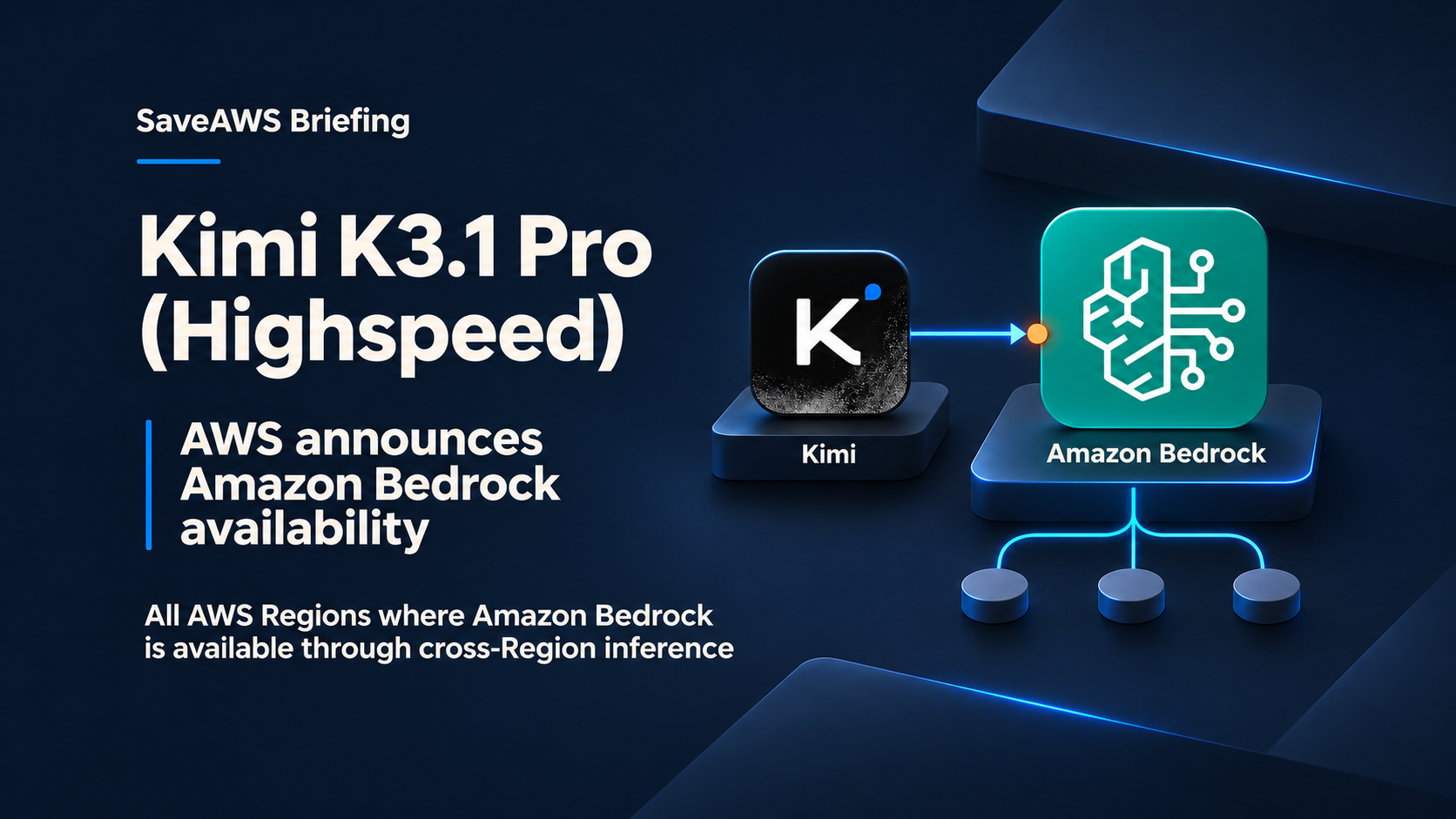
AWS What’s New published an official vendor announcement dated November 6, 2026, stating that Moonshot AI’s Kimi K3.1 Pro (Highspeed) is available on Amazon Bedrock. This is an AWS service-integration announcement about a third-party model, not an AWS-developed model release, community post, independent media report, or research paper.
According to AWS, the addition expands Bedrock’s open-weight model portfolio and supports agentic applications such as coding and document processing. AWS describes the Highspeed offering as delivering high output tokens per second, but the announcement provides no numerical throughput measurements or comparative benchmark results.
The stated availability is all AWS Regions where Amazon Bedrock is available, through cross-Region inference. That qualifier matters: the announcement should not be read as confirmation that the model runs locally within every Bedrock Region.
Which claims come from Moonshot AI?
The AWS announcement attributes several model characteristics directly to Moonshot AI. According to the model developer, Kimi K3.1 Pro is:
- An open-weight, natively multimodal agentic model.
- Equipped with a 1-million-token context window.
- Its most capable model to date in the 3-trillion-parameter class.
Moonshot AI also reports improvements in coding, 3D creation, financial research, and other agentic work. These are developer claims relayed by AWS, rather than independently verified findings presented in the announcement. The source does not include evaluation methods or results sufficient to establish how those improvements translate to a particular business workload.
The open-weight description also does not, by itself, establish licensing terms, deployment rights, or whether every capability is exposed through this Bedrock offering. Teams should check the applicable model documentation and terms before making architectural or commercial commitments.
Security, caching, and cost implications
AWS states that Kimi K3.1 Pro runs within the same security boundary as proprietary models on Bedrock. It also says the offering supports explicit prompt caching to reduce latency and input costs.
Those statements are relevant to enterprise evaluation, but they are not a substitute for a workload-specific governance review. In particular, organizations with data-location requirements should verify how cross-Region inference routing aligns with their policies rather than assuming that selecting a Bedrock Region guarantees local processing.
SaveAWS analysis: Prompt caching is worth evaluating when requests repeatedly include shared material, such as stable instructions or reference documents. However, the announcement does not supply pricing, cache conditions, or measured savings. No discount percentage or guaranteed cost reduction can be inferred from it.
Likewise, higher output speed is not the same as lower end-to-end workflow cost. An agentic task can involve multiple model calls, tool interactions, retries, and human review. A useful comparison measures the cost of an acceptable completed task, alongside latency and output quality, rather than output speed alone.
Practical next steps for teams
Before moving a production workload, use the announcement as a starting point for a controlled evaluation:
- Confirm access and routing. Check the Bedrock console and current documentation for model access, supported inference paths, and cross-Region behavior relevant to your deployment.
- Test representative work. Compare coding or document-processing tasks against your existing approach using the same acceptance criteria.
- Measure the full workflow. Record completion quality, total latency, token usage, retries, and review effort rather than relying on a model-level speed claim.
- Evaluate caching separately. Test suitable repeated-prompt workloads and inspect actual billing behavior before projecting any savings.
- Review governance requirements. Validate data handling, regional restrictions, model terms, and internal approval requirements before production use.
The business significance is an additional model option within Bedrock’s managed environment. Whether it improves a particular application’s economics or reliability remains an evaluation question, not a conclusion established by this release notice.
Original source
Source: AWS What’s New — Kimi K3.1 Pro (Highspeed) now available on Amazon Bedrock, published November 6, 2026. Model capability claims are attributed to Moonshot AI as reported by AWS; the practical recommendations above are SaveAWS analysis.
AWS What’s New
Kimi K3.1 Pro (Highspeed) now available on Amazon Bedrock · 2026-11-06