What AWS announced
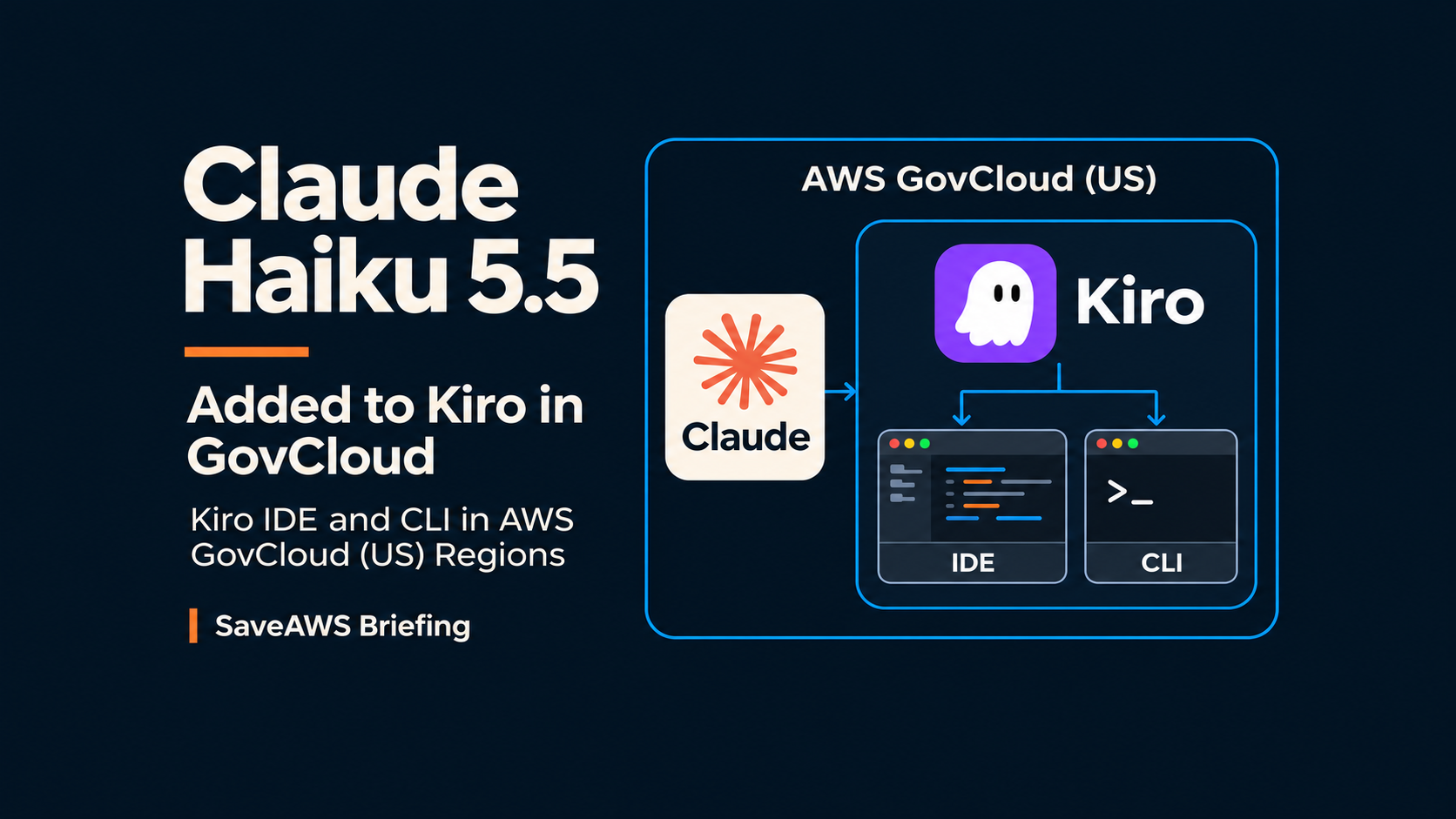
In an AWS What’s New announcement dated November 2, 2026, AWS states that Anthropic’s Claude Haiku 5.5 is available in the Kiro IDE and CLI for AWS GovCloud (US) Regions. According to the announcement, this brings all three Claude 5.5 models to Kiro in that environment.
The publisher is AWS, and the source is an official vendor announcement—not a community post, independent media report or research paper. Anthropic supplies the model; AWS is announcing its availability within Kiro. The stated scope is Kiro in AWS GovCloud (US), not a separate announcement of availability through Amazon Bedrock or every AWS environment.
Capabilities described in the source
AWS describes Haiku 5.5 as the fastest member of the Claude 5.5 family and positions it for high-volume work requiring quick responses. Those are vendor characterizations: the supplied announcement does not include independent benchmarks, measured latency results or workload-specific accuracy comparisons.
The listed use cases include:
- Summarizing and compacting long context.
- Classifying and routing requests.
- Processing text in bulk.
- Making small, targeted edits across multiple files.
- Acting as a parallel review subagent while Opus 5.5 and Sonnet 5.5 handle more demanding planning and coding tasks.
The announcement also specifies adaptive thinking with five effort levels, ranging from low to max, with medium as the default. It lists a 1M context window. That context capacity is a product specification, not evidence that every workflow benefits from filling the available window.
Credit multipliers need careful interpretation
AWS lists a 0.06x credit multiplier and says requests exceeding 100K tokens are billed at a 0.3x multiplier. These are credit-consumption multipliers, not standalone dollar prices or verified savings percentages.
The distinction matters for budgeting. A large context window and a lower listed multiplier do not, by themselves, establish the total cost of a development task. Teams still need to understand their applicable Kiro plan, credit accounting and request mix. The announcement does not explain every billing detail, including precisely how the token threshold is evaluated.
SaveAWS analysis: classify usage by request size before estimating costs. Workloads that frequently cross the stated threshold should be modeled separately from smaller requests. Evaluate completed-task consumption as well as individual requests, because retries, additional review and repeated edits may change the business outcome.
Business impact: another option for task routing
For teams using Kiro in AWS GovCloud (US), the practical significance is an additional model choice inside their development workflow. AWS’s suggested division of labor—Haiku for lighter tasks and parallel review, with other models handling harder work—offers a routing pattern worth testing.
That is an evaluation opportunity, not a guaranteed productivity improvement. A team could compare Haiku’s results on repetitive edits or classification against its existing approach, then reserve more demanding work for another model when testing supports that decision.
Availability in AWS GovCloud (US) should also not be treated as blanket approval for every sensitive workload. Organizations still need to review the applicable service documentation, data-handling requirements and internal authorization policies.
Practical next steps
AWS instructs users to update their Kiro IDE or CLI to the latest version, restart it and select the new model from the model selector.
Before wider adoption:
- Confirm access: check the model selector and relevant GovCloud documentation for your environment.
- Verify billing: establish how credits, the 100K-token threshold and the listed multipliers apply to your usage.
- Run a bounded pilot: test representative tasks and record output quality, response time, credit use and human review effort.
- Review controls: confirm that model selection and development practices meet organizational requirements.
- Monitor before expanding: use the monitoring and tracking guidance referenced by AWS, and contact your AWS account team where clarification is needed.
The source establishes an AWS-announced Kiro model addition. Whether that addition improves cost efficiency or delivery speed remains a workload-specific question that teams should answer with measured results.
AWS What’s New
Haiku 5.5 now available on Kiro in AWS GovCloud (US) · 2026-11-02