What AWS announced
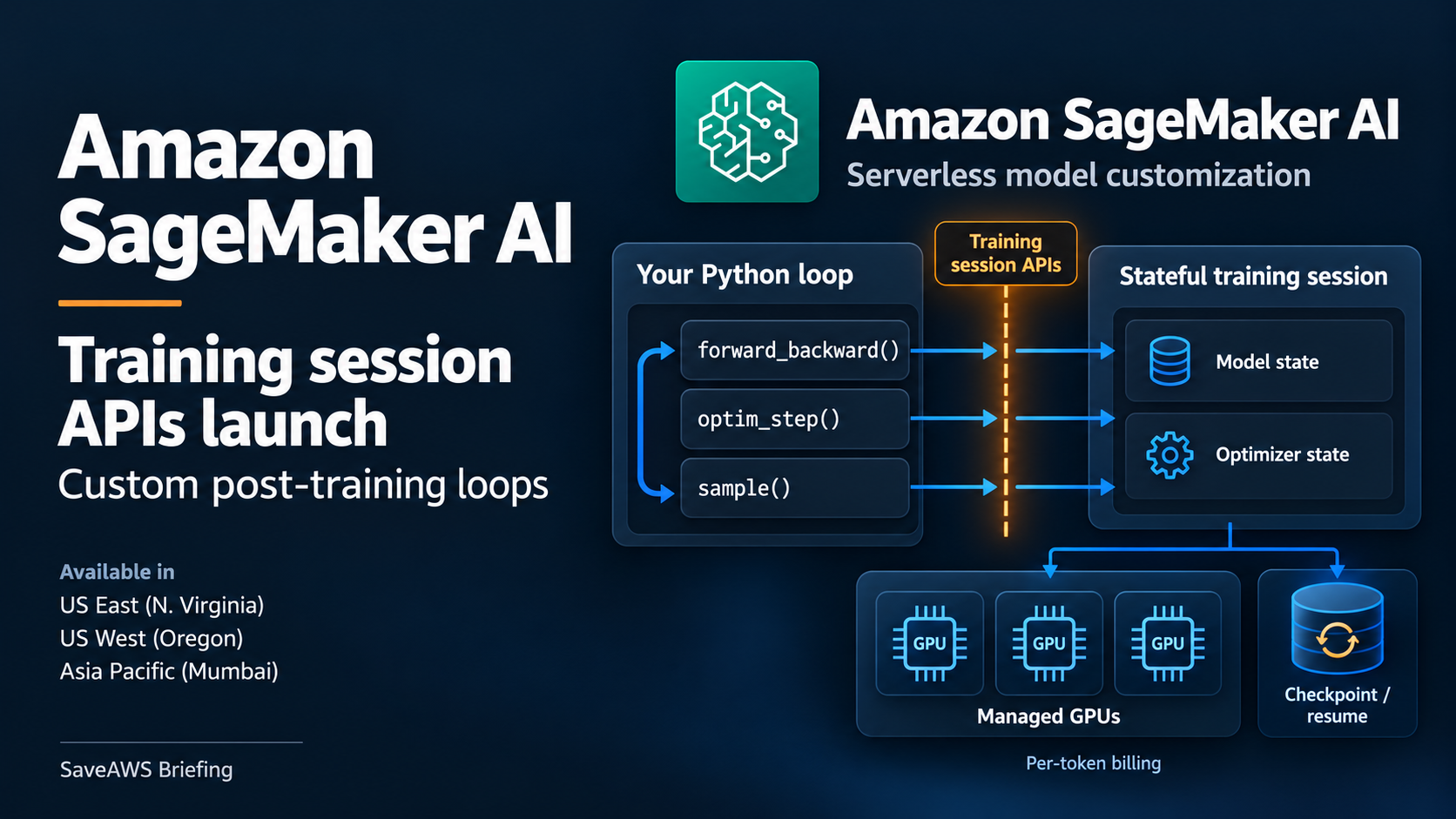
In its October 22, 2026 announcement, AWS introduced training session APIs for Amazon SageMaker AI serverless model customization. The APIs let developers write their own post-training loops while SageMaker AI manages the underlying GPU infrastructure.
AWS states that the APIs are generally available in US East (N. Virginia), US West (Oregon), and Asia Pacific (Mumbai). Teams should check this regional scope against their deployment and data-handling requirements before planning adoption.
The central change is algorithmic control. Rather than only selecting a managed training technique and model, developers can define the sequence of training operations themselves.
What the training session APIs do
According to AWS, operations such as forward_backward(), optim_step(), and sample() are exposed as API calls against a live, stateful training session. Developers can call these operations from their own Python code to build supervised fine-tuning, reinforcement learning, or custom training objectives.
AWS describes potential uses including a custom loss function, a new reinforcement-learning reward signal, a data curriculum, or an algorithm drawn from research. Teams can also implement their own versions of supervised fine-tuning (SFT) or direct preference optimization (DPO).
SageMaker AI handles the infrastructure tasks identified in the announcement:
- GPU allocation and model and LoRA loading.
- Distributed execution and fault recovery.
- Checkpoint storage and security.
AWS also says checkpointing and resume are built in. Alongside the APIs, it is releasing the SageMaker training sessions cookbook, with ready-to-run SFT and reinforcement-learning recipes that developers can adapt.
Business impact: more control without owning the GPU layer
SaveAWS analysis: This update may be useful for teams whose customization requirements extend beyond a managed training recipe. It separates control of the training procedure from responsibility for operating the GPU layer.
That could let machine-learning engineers focus more effort on objectives, reward functions, and experimental design. However, managed infrastructure does not remove the need to validate training behavior. Teams still need to assess data quality, algorithm correctness, model outcomes, and whether a custom approach justifies its engineering complexity.
A sensible adoption question is therefore not simply whether the APIs are more flexible. It is whether that flexibility addresses a measured limitation in the team's current customization workflow.
Billing: assess token consumption, not assumed savings
AWS states that billing is per token processed. It also says local computation, such as reward scoring, is not billed as GPU time.
SaveAWS analysis: This distinction matters when comparing workflows that alternate model operations with locally executed evaluation or scoring. The service's billing boundary should be considered separately from any compute resources a team uses outside the training session.
The announcement does not provide token rates or establish that this approach costs less than alternatives. A useful evaluation should measure token usage, external compute costs, engineering effort, and model quality for a representative experiment. Avoid treating serverless delivery as a savings guarantee.
Practical next steps
Start with a narrowly scoped experiment before redesigning an existing training pipeline:
- Check prerequisites. Verify supported models, SDK requirements, regional availability, and applicable quotas in the current documentation.
- Use a cookbook baseline. Run an appropriate SFT or reinforcement-learning recipe before adding custom behavior.
- Test session recovery. Validate checkpoint and resume behavior against your workflow's operational requirements.
- Measure quality and consumption together. Compare the resulting model against a baseline while recording token usage and other resource costs.
- Review governance. Confirm that data handling, access controls, and regional requirements fit your organization's policies.
AWS lists two starting paths: install the SageMaker Python SDK and clone the cookbook, or launch a notebook in SageMaker Studio and connect a coding agent. Choose the path that fits your team's development and review practices.
Official source
Official AWS source
Amazon SageMaker AI announces training session APIs for serverless model customization · 2026-10-22